Pilot Officer James Leo Daly DFC Navigator
101 Squadron, RAF Bomber Command, World War II
The Man
My great-uncle James 'Leo' Daly.
He was known to everyone simply as Leo. Leo was a schoolteacher. Educated by the Jesuits at St Patrick’s College, East Melbourne. Precise, patient, calm under pressure — qualities formed in a classroom that would serve him in ways he could not yet imagine when he stood in front of his students in the years before the war.
James Leo Daly was born on 23 May 1910, in Rochester, Victoria.
He enlisted in the RAAF on 10 October 1942, in Melbourne, at thirty two years old. By the time he began flying operations in October 1944, he was thirty four — ancient by the standards of Bomber Command, where the average age of aircrew was twenty and anyone over thirty was called "Dad." He volunteered anyway.
The Training
Before he ever reached a Lancaster, Leo trained as a navigator, wireless operator and gunner at No. 1 Wireless Air Gunners School (1 WAGS) at Ballarat, Victoria — a school purpose built for the task, raised as part of the Empire Air Training Scheme that fed aircrew from across the Commonwealth into RAF Bomber Command.
The classroom skills that had served him as a schoolteacher — precision, patience, the discipline of getting a calculation right the first time — were exactly what the instructors at Ballarat were trying to build in every trainee who passed through. For Leo, it was less a transformation than a redirection: the same steady mind, turned from a blackboard to a chart table.
From Ballarat, further training followed at No. 4(C) Advanced Flying Unit and No. 18 Operational Training Unit, refining the skills of dead reckoning navigation before he was posted operational. He left Australia on 27 December 1943, and arrived in the United Kingdom on 11 February 1944, before being posted to 101 Squadron — the posting that would ask everything of what he had just learned.
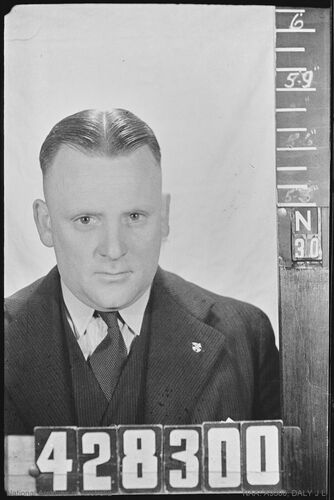
James Leo Daly - Enlistment 1942
The Squadron
He trained as a navigator and was posted to 101 Squadron, RAF Bomber Command — the most dangerous posting in the most dangerous air force in the world. 101 Squadron flew Avro Lancasters. But not ordinary Lancasters. These aircraft carried secret jamming equipment — codenamed Airborne Cigar — designed to disrupt German radio communications and protect the hundreds of bombers in the stream around them. The equipment worked. It also broadcast the aircraft's position to every German night fighter within fifty miles. 101 Squadron's motto was ‘Mens agitat molem’ — Latin for "mind over matter." For the men flying with the Airborne Cigar equipment, it was more than a piece of Latin on a crest. Every sortie meant carrying a device that made their own aircraft the most heavily targeted Lancaster in the bomber stream, and getting through it required exactly what the motto promised: nerve and discipline holding steady against odds the equipment itself had stacked against them. The Germans knew which Lancasters were jamming them. They hunted them specifically. A raid in Leo’s era typically meant four hundred to seven hundred four-engined bombers dispatched together — not flying in formation, which was a daylight American tactic, but strung out through the darkness in what crews called the bomber stream: individual aircraft, unseen and invisible to each other, flying the same route at the same height, relying on darkness and numbers rather than visible mutual protection. His own raid on Essen on 12 December 1944 involved 540 bombers — a single, ordinary night’s work for Bomber Command by that stage of the war.
To understand what Leo was flying into, the numbers tell their own story. Across RAF Bomber Command as a whole, 55,573 aircrew were killed out of 125,000 who served — a death rate of 44 percent. A Bomber Command aircrew member had a lower statistical chance of survival than a British infantry officer on the Western Front in the First World War. Bomber Command losses represented almost 20 percent of all British and Commonwealth personnel killed in action during the entire war, yet aircrew made up only a small proportion of total service numbers. Of every 100 men who flew, fewer than 30 could expect to complete a full tour of thirty operations during the worst periods of the campaign. For Australians specifically the toll was devastating. More than one in three RAAF personnel serving in Bomber Command were killed — accounting for 20 percent of every Australian combat death in the entire Second World War, from a group that represented only a fraction of total enlistments.
The enemy was not the only danger. Over 8,000 Bomber Command airmen were killed in accidents during training or non-operational flying alone. On the night of 7–8 November 1941, in a raid on Berlin, Mannheim and Cologne, 392 aircraft were dispatched into storms, thick cloud, ice and hail so severe that only 73 of the 169 bombers sent to Berlin even reached the city. Thirty seven aircraft were lost that single night — 7.4 percent of the whole force — many of them believed to have gone down over the North Sea from ice building up on their wings and fuel exhaustion in the terrible conditions, rather than anything the Germans did at all. Navigating through weather like that, in the dark, without modern instruments, was its own kind of combat. A standard Bomber Command tour was thirty operations, not exceeding two hundred flying hours.
Leo’s own signed record shows thirty two sorties and 199 hours, 35 minutes — he flew a genuinely complete tour, almost to the exact hour, with two sorties to spare. And then there was 101 Squadron. At full strength the squadron operated 42 aircraft with eight crew each — approximately 336 men at any one time. Over the course of the war 101 Squadron lost 1,176 aircrew killed — the highest of any RAF squadron — and 145 Lancasters destroyed on operations. The squadron effectively lost its entire complement of men more than three times over. Only three other squadrons in the entire RAF lost more aircraft. Leo Daly flew thirty two sorties in those aircraft. The statistics say he probably shouldn't have come home. He did.
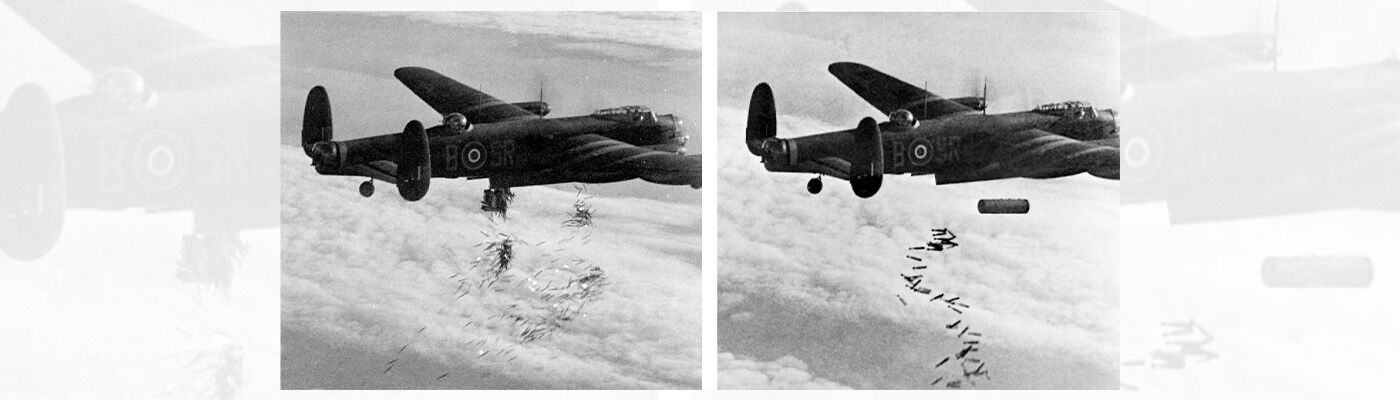
Lancaster I NG128 Dropping Load - Duisburg - Oct 14 - 1944
The Sorties
His own signed record — a RAAF biographical questionnaire completed on 7 April 1945 — puts a precise figure on his tour: 199 hours and 35 minutes of operational flying, across thirty two sorties. Ten were flown in daylight. Twenty two were flown at night.
His last sortie was to Potsdam, on 14 April 1945. Potsdam was no ordinary target — it was the seat of Nazi military headquarters, the heart of the German High Command, the place from which the orders that had prosecuted six years of war had flowed. Bombing Potsdam in April 1945 was striking at the very nerve centre of the regime in its final days. The war in Europe ended less than a month later. It is worth noting that Leo signed his own biographical questionnaire — the same form quoted throughout this account — on 7 April 1945, exactly one week before that final raid on Potsdam. Whether that was simply routine administration, or something else entirely given what he knew he was about to fly into, is impossible to say. But the timing invites the thought. He flew thirty two times. He came home every time. A schoolteacher from Australia, navigating in the dark, on missions that helped starve Germany of fuel, strangle its rail network, support the armies advancing on the ground, and finally strike at the headquarters of Nazi Germany itself. That’s a remarkable final entry in any logbook.
The Navigator's Table
Leo Daly's office was a curtained table roughly the size of a school desk, positioned just behind and below the pilot of his Lancaster. On it sat his charts, his instruments, his logs. A small lamp provided just enough light to work by. The curtain was drawn tight — not for privacy, but to stop the glow of his instruments being visible to enemy fighters in the darkness outside.
He navigated by dead reckoning — calculating position from a known starting point using speed, heading and time. Simple in principle. Brutally difficult in practice. Wind at altitude bore no resemblance to the forecast. The pilot was constantly adjusting heading. Enemy flak forced evasive action that threw every calculation off. Leo had to track every deviation, every correction, every lost minute, and continuously update his picture of where they were. When skies were clear he could take star sights through a small astral dome above his table — a bubble sextant pressed against the Perspex, measuring the angle of a star above the horizon. Three stars, three readings, a triangle of position lines on the chart. If the triangle was small, he was accurate. If it was large, he had to judge which corner was most likely the truth. Around him, invisible in the dark, were hundreds of other Lancasters. The bomber stream stretched for miles — a river of aircraft flying the same route at the same height, none showing lights, none able to see the others.
Any navigational error didn't just risk Leo's crew. It risked a collision with another Lancaster materialising from the blackness without warning.
The Devotional Medal
Before every mission there was a ritual. Leo’s crew — young men mostly, teenagers and early twenties — would ask him before boarding whether he had his devotional medal with him. Given his own Catholic upbringing and Jesuit schooling, it was likely a small Catholic devotional medal — a saint, or the Sacred Heart — the kind many airmen of the era carried, whatever their own faith, as a private hedge against the odds. It was not a casual question. These men were flying into the most dangerous airspace in the world and they took such things seriously. On one occasion Leo had left it behind in barracks. The crew refused to board without it. They made him go back and retrieve it — and then held the aircraft for a rapid take off to rejoin their squadron.
Thirty two sorties. Leo came home every time. Make of that what you will.
The Decoration
Leo Daly was awarded the Distinguished Flying Cross. The citation read simply that he had displayed "the utmost courage, fortitude and devotion to duty." The Cross itself had been instituted by the King in 1918, “to signify his appreciation of acts of valour, courage, and devotion to duty, by officers in the Royal Air Force and in Air Forces of Self-Governing Dominions beyond the Seas,” granted to those “recommended for an act or acts of valour, courage, or devotion to duty whilst flying in active operations against the enemy.” Its award entitled the recipient to append the initials ‘D.F.C.’ to his name — initials Leo, by every account, never once used. Around 185,000 men served as aircrew across the whole of the RAF during the Second World War, in every command, not only Bomber Command. Set against roughly 20,000 DFCs awarded across the RAF and Commonwealth, something in the order of one man in every nine or ten aircrew ever received one.
It was not a common decoration. Between 1918 and 1972, only 2,391 Australians ever received the Distinguished Flying Cross, and most of those awards — like Leo’s — were earned in the skies over occupied Europe during the Second World War. Set against more than 20,000 DFCs awarded across the entire Royal Air Force and Commonwealth in that war, an Australian recipient was the exception rather than the rule — roughly one in nine Australians.
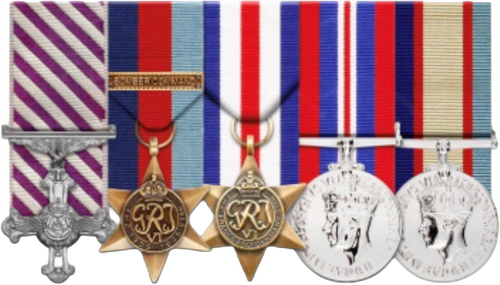
James 'Leo' Daly's - Medals
including the Distinguished Flying Cross
Leo was not simply one of many. He was one of a genuinely select few. Closer to home, the school where Leo first trained tells the same story in miniature. More than 151 personnel who passed through No. 1 Wireless Air Gunners School at Ballarat are recorded as having received a gallantry citation during the war — the major ones being the Distinguished Flying Cross and its non-commissioned equivalent, the Distinguished Flying Medal, both awarded for “an act or acts of valour, courage or devotion to duty whilst flying in active operations against the enemy.”
Of those 151, twenty five were killed in action. Leo was one of the ones who came home. Understated in the way only the British military can manage. What it meant in practice was this — a thirty four year old Australian schoolteacher flew twenty two night missions in the most targeted aircraft in the most dangerous squadron in Bomber Command, navigating in total darkness without lights over the most heavily defended airspace in the world, and brought his crew home every time.
After the War
Leo was discharged from the RAAF on 18 December 1946, from his posting at RAAF Laverton, Victoria — more than four years after he had enlisted, and well over a year after the war in Europe had ended. His final sortie, to Potsdam, had been on 14 April 1945 — barely three weeks before the war in Europe ended on 8 May 1945.
He was not discharged until December 1946 and it seems likely he was still in England on VE Day when the war in Europe ended — possibly on leave, his operational tour behind him — among the crowds and celebrations he would spend the rest of his life quietly commemorating from home, on the other side of the world, every year afterward. After the war he marched every Anzac Day with the Odd Bods — the association formed in 1947 by RAAF personnel who had served embedded within RAF and allied units during the war.
Men scattered across European commands, without a home unit association back in Australia, who found each other and kept faith with each other until the end. Every Victory in Europe Day, the Odd Bods held a service at the Shrine of Remembrance in Melbourne, and Leo attended each year, among the men who understood what he had done because they had done it too.
Leo returned to teaching after the war. Former students recall a "Mr Daly" — known affectionately to some as "Pop Daly" — who taught grades four through six at Spotswood State School in Melbourne's western suburbs through the 1950s, moved to Kingsville State School, Yarraville, for a period in the early-to-mid 1960s, and then returned to Spotswood as headmaster in the late 1960s.
He was remembered as "a very strict and good teacher," and one former pupil recalled him specifically as "a WW2 hero… air force I think."
He and Margaret had no children. But they were deeply loved.
Leo passed away on 18 November 1985. His wife Margaret followed in 1989.
From Leo's service there were three things the family held — his medals, his flight logbook, and a large painting of a Lancaster bomber under fire and searchlights.
The painting is believed to have been given to the RAAF Museum at Point Cook in Victoria.
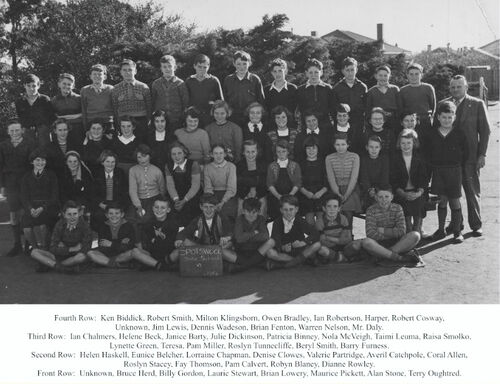
Spotswood State School - Leo Daly Teacher (Top Right)
The Legacy
Leo and Margaret had no children of their own. In the absence of direct descendants, it has fallen to his nieces, nephews, and their own children to carry his memory forward — and it is in that spirit that his story is told here.
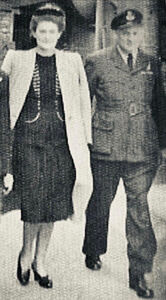
Leo & Margaret
at the races
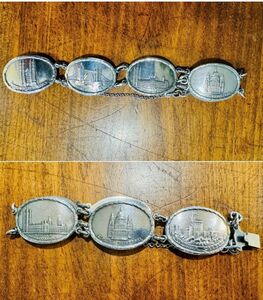
Souvenir Bracelet from wartime London
purchased for Margaret
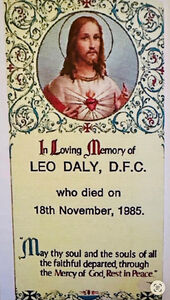
James 'Leo' Daly
1910 - 1985
Leo is not forgotten.
→ His DFC citation sits in the Australian War Memorial.
→ His service record has been digitised and is held by the National Archives of Australia.
→ His flight logbook recorded every target, every sortie, every night he climbed into a Lancaster and navigated into the dark.
→ The bracelet he sent from wartime London is still worn by my grandmother.
→ He came home from thirty two operations over Germany and occupied Europe and lived a quiet life, saying nothing much about any of it.
If he said anything at all about the war, it was one line, repeated so often that it became the thing most people remember of him: how lucky I am to be here. That is perhaps the most remarkable thing of all. He was a schoolteacher who became one of the most decorated navigators in the most dangerous squadron in Bomber Command. He was needed, and he rose to it — completely, without fanfare, and with the same steady competence he had brought to a classroom full of children before the war came.
Leo was not one of the fallen- he came home and lived another 40 years. But the same debt of memory belongs to him as to those who didn't return, and it feels right to close his story with the words spoken over them every year, on ANZAC Day and Remembrance Day, at the Shrine and everywhere else his generation gathered to remember what it cost.

They shall grow not old, as we that are left grow old:
Age shall not weary them, nor the years condemn.
At the going down of the sun and in the morning
We will remember them.
We will remember them.
Lest we forget.
I am his great-nephew and I hope telling Leo’s story keeps his story present.
Liam Timms.
Sydney, Australia.
30 August 2026.
Download unedited full version: James Leo Daly DFC - Bomber Command Navigator August 2026