Raymond Lewis Merrill
Air Force Association (SA)
South Australian Aviator Profile
FLGOFF Raymond Lewis Merrill DFC
World War 2
Raymond Lewis Merrill was born on 17 September 1922 at Port Augusta, the middle of three sons to Charles Lester Merrill and Ivy Louisa Cilento.
His father served in the 9th Light Horse Regiment on Gallipoli as a Lance Corporal before being wounded from a gunshot to the head in August 1915. He subsequently lost an eye and was medically discharged from the Army returning to Australian at the end of 1915 after 12 months service.
Post war, he operated the ferry between Port Augusta and Port Augusta West and then worked for the Commonwealth Railways. Meanwhile, Ray grew up in Port Augusta attending Port Augusta Primary School and Port Augusta High School. He proved to be quite a sportsman and athlete excelling at athletics, football, and cricket.
After school, Ray gained employment with the Commonwealth Railways as a purchasing clerk.
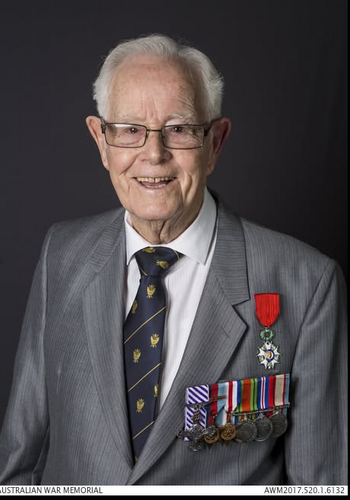
Portrait image of Ray Merrill DFC taken as part
of an Australian War Memorial WW2 initiative. (AWM)
Images courtesy of Australian War Memorial,
Department of Defence, Luke Scott Images and AFA-SA.
Ray’s older brother, Frederick, a law clerk at the Port Augusta Local Court, enlisted in the RAAF in September 1941 as trainee aircrew.
Completing flying training at Cunderdin and then Geraldton, he obtained his Wings in September 1942 and was selected for duty in the United Kingdom.
He completed 33 operational missions and one complete tour with No 463 Squadron (RAAF) from November 1943 to June 1944 flying Lancasters.
He then completed a further half tour with 463 SQN flying 14 operational missions from June to August 1944 before being posted to No 242 Squadron (RAF), a transport squadron, flying Stirling and Lancaster aircraft from August 1944 to August 1945.
He was awarded the Distinguished Flying Cross in 1944 for his service with 463SQN.
Both served in Bomber Command. Both flew missions on D-Day. Both were awarded the DFC. (AWM).
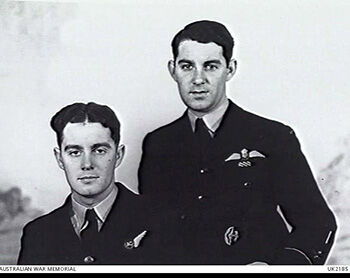
Ray Merrill (left) with his brother Fred (right)
taken during World War 2 in England.
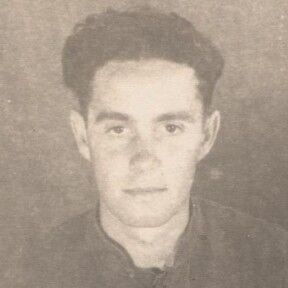
Enlistment photo of Ray Merrill in 1942. (NAA)
Ray enlisted in the RAAF about seven months after his brother on Anzac Day 1942 at No 5 Recruit Centre, Adelaide, at the tender age of 19. He recalls that shortly after swearing the oath of allegiance confirming his enlistment, he received telegram from the Commonwealth Railways in Port Augusta denying his enlistment due to his position being a reserved occupation. However, it came too late and so, Raymond was off to war.
As trainee aircrew, he completed initial aircrew training at No 4 Initial Training School, Victor Harbor, from April to May 1942. Ray openly admits that he did not want to be a pilot because he did not think “he had brains to be like his brother.” The Air Force provided some initial training as a wireless operator, but Ray still questioned that trade and so was selected finally to proceed as an air gunner.
He attended No 1 Wireless and Gunnery School (1WAGS), Ballarat, from June to December 1942. One of three such dedicated WAGS in Australia, the unit was established in April 1940 as part of Australia’s commitment to train aircrew as part of the Empire Air Training Scheme. Its purpose was to train Wireless Operators and Air Gunners. More than 6,000 trainees passed through the school from 1940 to 1945.
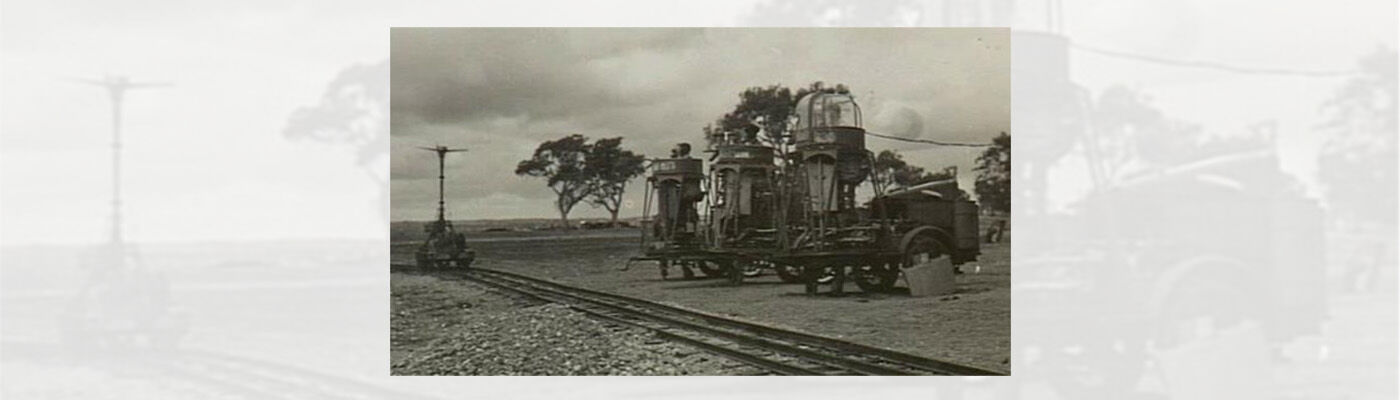
Gunnery training at No 3 Bombing and Gunnery School, West Sale, during World War 2. (AWM)
During December 1942 and early January 1943, he attended No 3 Bombing and Gunnery School, West Sale, where he obtained his Air Gunners Badge on 7 January 1943. During the training, he completed eight hours flying performing air to air gunnery on the Fairy Battles. He recalls that they would take two air gunners on the training flights and with one in the lower cockpit/fuselage and one in the gunners position ready to shoot and then swap over mid-flight. The problem was the lower position lacked visual with the horizon and thus, was prone to airsickness. While at West Sale, he knew one of the instructors who came from Port Augusta and thus, helped him through the training.
Completing his air gunnery training, Ray was initially posted to Northern Australia where he spent six months with No 55 Operational Base Unit at Birdum 500km south of Darwin and No 2 Squadron (RAAF) and No 18 (Netherlands East Indies) Squadron based at Batchelor Airfield which was closer to Darwin. However, he was soon selected for duty overseas and on 4 August 1943, embarked on the HMT Devonshire, a relatively new British troopship, sailing for Britain via the Panama Canal arriving at Cardiff, Wales, one month later.
Arriving in Britain, Ray was posted to No 11 Operational Training Unit based at RAF Westcott in Buckingham in southern England. At the operational training units, aircrew would form a crew and convert onto a heavy bomber. It was at 11OTU where Ray was integrated into his seven person Bomber crew with whom he would all fly his operational sorties. He tells the story of how he was a sitting in the mess and a pilot walked in a yelled “I’m looking for a rear gunner” to which Ray got up and responded, “you’ve got one.” The crew comprised SGT Ron Eccleston (Pilot, RAF), Chic Rutledge (Navigator, RAAF), Ron Shorter (Flight Engineer, RAF), Paul Adams (Bomb aimer, Mauritius), Robert Allen (Mid-upper gunner, RAF) and Edward House (wireless Operator, RNZAF). The quite multi-national crew formed a remarkable team and went on to complete 36 missions together. From September 1943 to January 1944 at 11OTU, Ray flew the Vickers Wellington Bomber, a relatively successful twin-engine heavy bomber aircraft developed during the 1930’s that saw service throughout the war and was the mainstay of the bomber operational training units. Ray obtained 82 hours on the aircraft while at 11OTU.
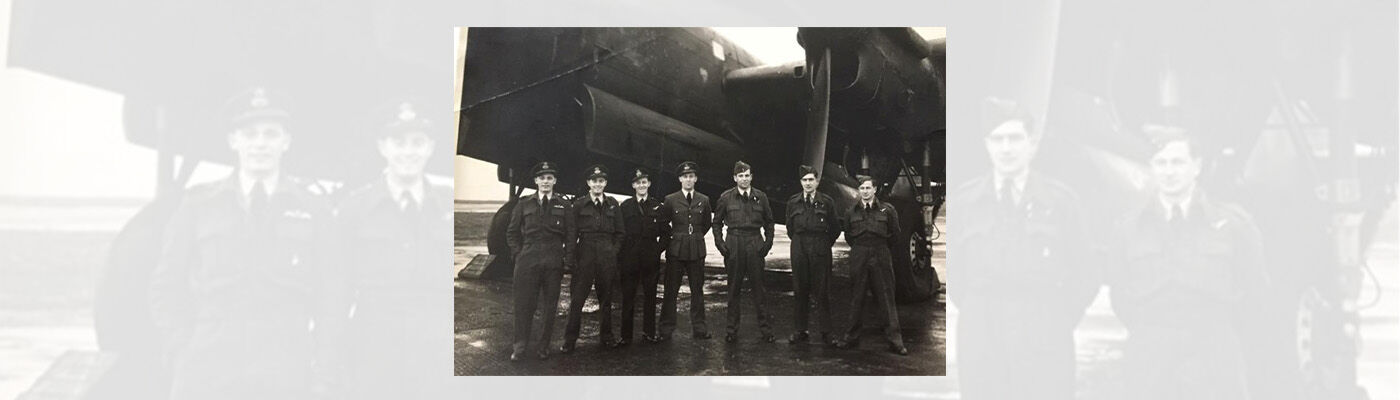
Ray Merrill and his crew who formed at 11OTU and remained together for 36 missions at 218SQN (RAF).
From Left Ron Ecclestone, Ray Merrill, Chec Rutledge, Ron Shorter, Paul Adams, Bob Allen, and Ted House. (Merrill Family)
Ray and his crew were then posted to No 1653 Heavy Conversion Unit based at RAF Chedburgh in eastern England where they converted on to the four-engine Short Stirling aircraft from January to April 1944 obtaining 48 hours on the heavy bomber.
Finally, completing all his flying training, Ray was posted to No 218 (the Gold Coast) Squadron on 25 April 1944 – exactly two years after he had enlisted into the RAAF at Adelaide.
A World War 1 unit reformed in 1936 to operate the Hawker Hind and then the Fairey Battle from 1938, the unit saw service in the Battle of France before having to o be withdrawn faced with significant losses.
The unit converted to the Bristol Blenheim, the Vickers Wellington and then the Short Stirling in December 1941. It was known as No 218 (Gold Coast) Squadron after the Governor of the Gold Coast (modern Ghana) and people of the Gold Coast officially adopted the squadron.
218 SQN Badge
Several months after arriving at the squadron, Ray and his crew were in one of six 218 SQN Stirling aircraft tasked with participating in a critical mission to drop window off the coast of Calais to simulate an invasion force and divert German attention away from the Normandy beaches on D-Day.
Launching just before midnight on the 5 June and reaching the target area in the early hours of the 6 June, Ray threw window through the bomb bay at six second intervals to spoof German coastal radars as the aircraft flew repeated approaches to the coastline for several hours. There were 13 in the crew including six crew to process the window in the aircraft. Called Operation Glimmer, the unheralded operation proved successful misleading German forces and leadership to believe an invasion was occurring at Calais resulting in two German Panzer Divisions remaining in the area for several weeks.
On their return to base, Ray and his crew observed the real invasion fleet crossing the English Channel for Normandy – a spectacular sight he says he will never forget. The mission was a complete success and the next day, the crew received a message from headquarters to say that the success was beyond expectations.
Ray flew 15 operational missions and over 66 hours on the Stirling with 218SQN.
He once described the aircraft as “good, slow, wonderful old work horses” noting they did have performance issues including speed and altitude.
Halfway through his operational tour with 218SQN, the unit converted to the Avro Lancaster in August 1944. On the 9th of August, Ray and his crew flew a mission in a Stirling and the next day, they flew their conversion sortie in a Lancaster.
Eight days later on the 18 August and with only 4½ hours conversion flying time, Ray embarked for his first operational mission – a strike mission targeting Bremen, Germany, in a Lancaster.
Ray would complete 21 missions on the Lancaster; an aircraft he greatly admired declaring it the world’s best bomber and without the aircraft, the allies would never have won World War 2.
He once commented in an Air Force Centenary video that “The Stirling was a good aircraft, but the Lancaster was a like a Rolls Royce compared to a Holden – it was a magnificent aircraft.”
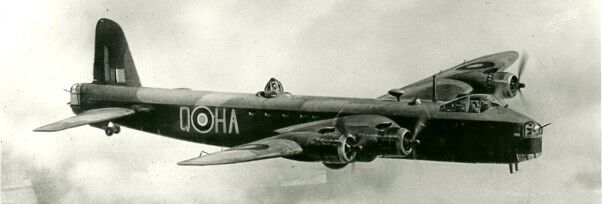
No 218 Squadron Short Stirling Bomber in flight. (AWM) in flight. (AWM)
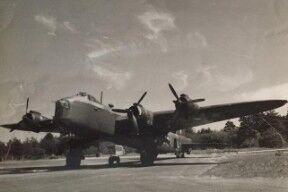
A 218 SQN Stirling on the flightline (Ray Merrill)
Ray tells the story of one night mission where he had a close encounter with a Messerschmitt Bf-109 fighter. Ray’s Lancaster was just outside a searchlight cone and 20m away was the German fighter in the searchlight cone. Ray could see the pilot’s face. Ray elected to play it safe and did not fire his tail gun believing that if he missed, they were certain to be shot down by the fighter. It was the closest he ever got to the enemy. He later profoundly recalled it wasn’t his job to shoot the fighters down – he was there to protect the crew and get them home safely.
This was no more typified than on his 19th operational mission - a night bombing mission - when Ray’s Lancaster flying at 10,000 feet suddenly got hit by four incendiary bombs dropped from a Lancaster above them.
The small bombs crashed into the aircraft’s fuselage and started to ignite threatening to cause catastrophic failure.
Ray, sitting in the tail turret, got up and threw the igniting incendiaries out of the fuselage through open bomb doors and holes in the fuselage from which they had entered.
There is little doubt that Ray’s actions on this mission saved the aircraft from suffering catastrophic failure and the lives of the crew.
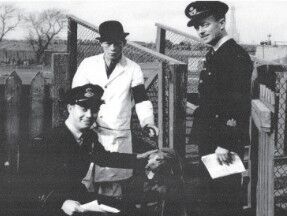
He also tells the story of when he joined fellow unit members in recovering bodies from a 218 SQN aircraft that crashed killing all on board while attempting to land at the airfield after a mission. The scenes were horrendous particularly for 20-year-old Ray as he picked up the body of a young airmen he knew and the head came away. Ray later embarked on a mission that night and returned to his barracks to find seven empty beds of the crew he had recovered earlier in the day.
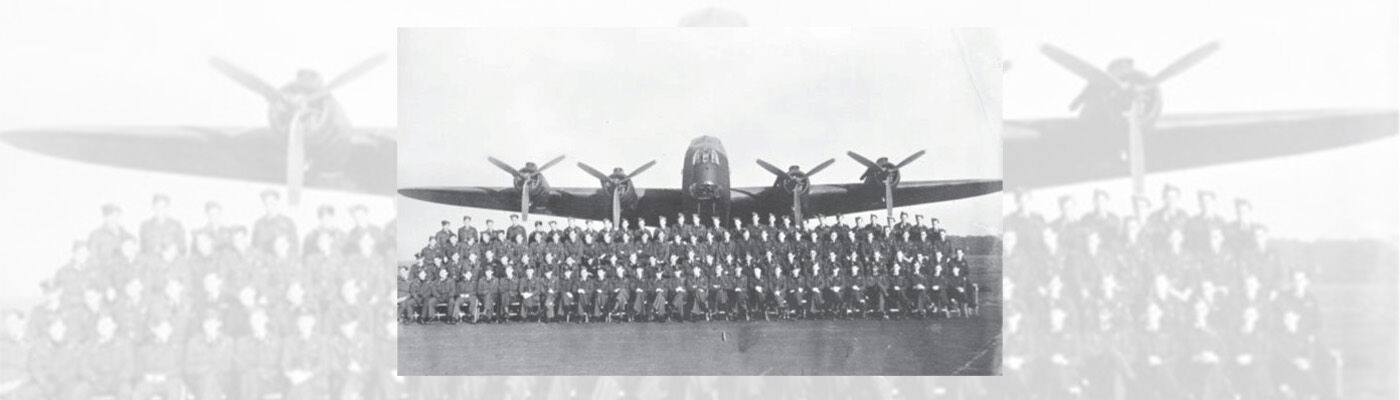
218 SQN aircrew in front of a squadron Short Stirling bomber aircraft at RAF Woolfox Lodge, England, in 1944.
(AWM) [Ray Merrill with Bluey the greyhound] Ray Merrill (left) with Bluey - the greyhound that won at Sheffield on the day Ray was meant to receive his DFC from King George. (Ray Merrill)
Ray went on to complete 36 missions in Bomber Command – six more than a normal tour of duty.
He was awarded the Distinguished Flying Cross – the Citation stating for “Skill and fortitude in operations against the enemy.”
He was invited to Buckingham Palace to receive the award from King George. But he was torn as the presentation was to be made on the same day a favourite greyhound of his, a one-eyed dog called Bluey, was scheduled for a big race at Sheffield. If it drew the barrier, it was unbeatable.
Needless to say, King and country did not win on the day, but Bluey did and so did Ray and his mates at the track.
His Commanding Officer berated him for not going to Buckingham Palace to receive his DFC, but the award eventually found its way to Ray back in Australia sometime later.
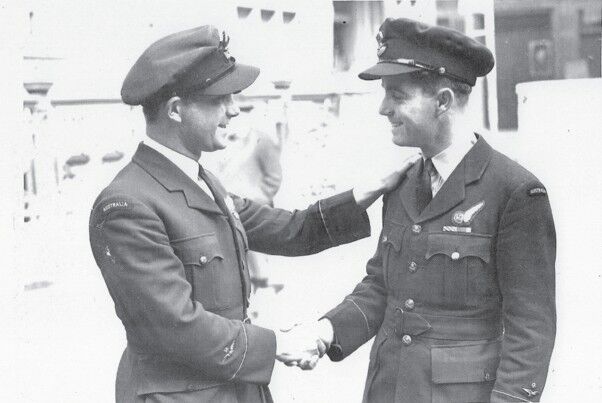
Ray Merrill (right) being congratulated by his brother, FLGOFF Fred Merrill DFC,
for receiving his own DFC in 1944. (Ray Merrill)
He was commissioned in August 1944 as a Pilot Officer Ray Merrill (left) with Bluey - the greyhound that won at Sheffield on the and promoted to Flying Officer in February 1945. day Ray was meant to receive his DFC from King George. (Ray Merrill)
Meanwhile, completing his operational tour at 218 SQN, Ray was posted to No 1653 Heavy Conversion Unit now based at RAF North Luffenham where he served a gunnery instructor at the same unit he had converted onto the Striling aircraft in early 1944.
Ray returned to Australia in July 1945 and was discharged from the RAAF in November 1945 as a Flying Officer. Completing three and half years’ service including a full operational tour in Bomber Command and a subsequent instructor posting.
Ray’s awards included the Distinguished Flying Cross, the 1939 – 1945 Star, France and Germany Star, Defence Medal, War Medal 1939 – 1945, and the Australian Service Medal 1939 – 1945. In 2015, he was awarded the Légion of Honour by the French Government.
Post war, Ray initially returned to Commonwealth Railways.
He then joined his brother in running an electrical business in Port Augusta before working as a bookkeeper on a sheep station northwest of Port Augusta, as a distribution manager with Orlando Wines in Tanunda and as a public relations manager with United Australia in Adelaide.
He retired aged 60 in 1982 living in the Adelaide area.
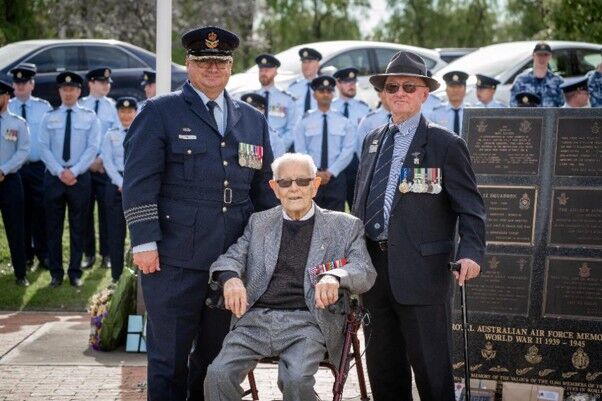
Ray Merrill with GPCAPT Greg Weller and Dr Robert Black
(Air Force Association Vice President) at the 2023 Bomber Command Commemorative Service in Adelaide (Luke Scott Photos)
In recent years, Ray Merrill has been warmly embraced by RAAF Edinburgh and the Air Force Association (South Australia) as one of Adelaide’s treasured and few remaining Bomber Command veterans. He is a regular attendee at Adelaide Air Force and ANZAC Day Commemorations. Noting his unique work with 218SQN for the D-Day Landings, a Conference Room at the RAAF Edinburgh based No 462 Squadron, is named after him. In 2021, Ray featured in one of the Air Force’s 10 Iconic Aircraft videos on the Lancaster aircraft.
In 2023, Ray presented to AIRCDRE Adrian Maso, Senior Air Force Representative South Australia and Commander Air Warfare Centre, a special letter signed by General Dwight Eisenhower, Supreme Commander of the Allied Expeditionary Force in Europe, addressed to airmen, soldiers and sailors participating in the D-Day Landings.
It is part of a display incorporating a biographical profile and several images of Ray Merrill to ensure the remarkable contributions and sacrifices of Australia’s World War 2 generation are not forgotten and serve to inspire future generations of aviators.
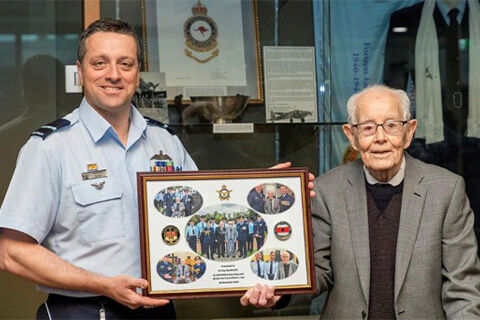
AIRCDRE Maso presents Ray Merrill with a special Memento in November 2023 at RAFA Edinburgh.
(Department of Defence)
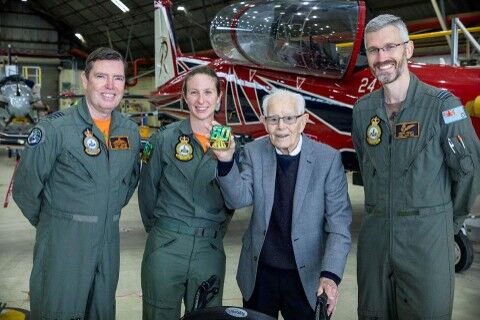
Ray Merrill with ARDU aircrew during
a visit to RAAF Edinburgh in 2023
Ray passed away on the 16 July 2026 age 103
Greg Weller
Vice-President
Air Force Association [SA] November 2023